1. Introduction
We are a group of residents campaigning for better housing in our neighbourhood. We absolutely recognise the need to build new homes and support the regeneration of neglected estates and underused sites in principle.
We also know the difficulties many people in Camden experience in trying to find suitable housing, particularly those who are on the long wait list for council housing. The delivery of social and affordable housing must therefore be a key priority.
What we have been seeing across the borough, however, is the adoption of a private sector-led approach driven by profit rather than public purpose, which seeks to dramatically change the nature, urban landscape, density and social make-up of our neighbourhood.
The proposal for the development of a ‘Camden Film Quarter’ on Regis Road is a prime example of this approach. It seeks to concentrate an amount of height and density in a small area that is disproportionate for this part of Kentish Town. Some of the tallest blocks proposed sit close to existing homes and community facilities, where the impact of this development – including loss of light, six years of construction, traffic and air pollution – will be felt most severely.
In section 2, we list the policies we believe this proposal is in breach of and continue to expand on our key concerns in section 3, which include:
- The types and location of affordable homes
- The height of the buildings
- The impact on surrounding areas, including:
- Strained services and infrastructure
- Obstructed views
- Construction and traffic
- Low quality green space
- Environmental impact
In the final section, we also address concerns we have about the cumulative impact of multiple developments currently at or close to planning application on the neighbourhood.
2. Executive Summary of Policy Breaches
The proposed scheme contravenes the following policies, which we will reference in the sections below:
- London Plan D1/D9, which supports mid-rise development and sensitive transitions
- Local Plan A1/A2 and London Plan design policies
- Local Plan T1/T2 and London Plan T4, which require safe, feasible construction logistics
- London Plan G1/G4 or the Regis Road SPD’s expectations for a generous, connected public realm.
Kentish Town Neighbourhood Plan policies SW1 (support for small businesses) and Spatial Policy SP2: Kentish Town Potential Development (KTPDA)
3. Detailed Explanation
3.1. Types and location of affordable homes
Camden Council has a target of 50% affordable housing for developments on its land, which Yoo Capital says it plans to build on Regis Road. As the affordable homes are being delivered through cross-subsidy, there is a high risk of this not being followed through due to the complexity of Yoo Capital’s scheme, which could be adversely affected by construction costs and enable the developer to seek reductions due to viability.
The type of affordable housing most urgently needed in Camden are family-sized units. However, of the affordable homes proposed by Yoo Capital only 28% are 3-bed flats, and none are 4-beds.
Yoo Capital’s application therefore does not provide the kind of housing mix that is needed, and therefore the claim that this development addresses the housing crisis in Camden is misleading.
In the current plans, all of the housing is squeezed into the west end of the Regis Road development area and only includes high-rise towers of up to 73.7 meters (up to 24 storeys), grouped closely together, which will be blighted by the close proximity to the film studio building.
In addition, the social housing, which replaces that being demolished at Holmes Road, will be built over the new recycling centre, to be relocated into a smaller facility also immediately adjacent to existing homes as well as a school and a nursery. We are concerned about the safety of this proposed location. There are over 300 fires in UK recycling and waste sites annually, many of which are caused by the incorrect disposal of batteries.
This aspect of the proposal is not acceptable as it sends the signal that social housing tenants should put up with the safety risk as well as the smell, noise, traffic etc. associated with the recycling centre.
Policy D3: Design Principles of the KTNP states that: “Proposals must be based on a comprehensive understanding of the site and its context [and] must be well integrated into their surroundings and reinforce and enhance local character.”
3.2. Height of buildings
A 24-storey Heathgate tower as well as bulky mega-studios and the Inkerman blocks are proposed to be built a short distance from 2–4 storey homes at Cressfield and Woodyard Closes, a nursery, the City Farm and sheltered housing. This scale is out of context and conflicts with London Plan D1/D9, Local Plan A1/A2, the Kentish Town Neighbourhood Plan, and the Regis Road SPD, which supports mid-rise development and sensitive transitions.
The height of these buildings is a design choice rather than a policy requirement and is not necessary to achieve the same quantum of affordable housing, which could be delivered through better distributed massing that avoids concentrated harm to vulnerable neighbours and community facilities.
The proposed towers are up to three times the usual permitted maximum height. This means they are potentially in contravention of the Tall Buildings section of Camden’s new draft Local Plan (Policy D2).
In addition, the application contravenes the Kentish Town Neighbourhood Plan policies SW1 (support for small businesses) and Spatial Policy SP2: Kentish Town Potential Development (KTPDA), which states: “The site is currently occupied by mainly single or double-storey sheds, open-air yards, car parks and the access road. Future development should reflect the capacity, density and scale of this inner London location.”
We reiterate that we are not opposed to the building of new housing, but insist that this must be done in ways that is within an appropriate scale and considers the impacts on the neighbourhood. The proposed tall buildings would remove open sky, overshadow existing homes and community facilities and permanently change the residential character of Kentish Town.
3.3. Impact on surrounding areas
The impact on existing buildings, homes, streets and community facilities of the proposed development is multi-faceted and substantial. We outline the types of impact we are most concerned about below.
3.3.1. Strained services and infrastructure
The increase in population resulting from this proposal would be substantial, particularly when considering this development in tandem with others planned in the same area (see section 3.5. for further analysis).
The planning application does not take into account the impact of such a significant increase in residents and commuters on existing residents (such as at City Farm and Cressfield and Woodyard Closes) and on already strained local physical and social infrastructure (such as public transport, education and health care facilities).
The applicant has not demonstrated that the local road network or public transport can absorb the traffic and servicing demands of a major studio complex and hundreds of new homes, contrary to London Plan T1/T4.
It also does not provide a solution for where the demolished Holmes Road Depot will be rebuilt (refurbished recently at a cost of £8.4m).
3.3.2. Obstructed views
The Environmental Statement (ES) omits verified views from the closest and most affected locations: Cressfield Close, Woodyard Close, Gillies Street, Kentish Town City Farm and the nursery. There are no images showing the tower from the closest streets that would feel the impact most.
These omissions make the ES incomplete under the EIA Regulations, meaning the application cannot be properly assessed or lawfully determined. This will have a significant adverse effect on Kentish Town City Farm where privacy is a requirement.
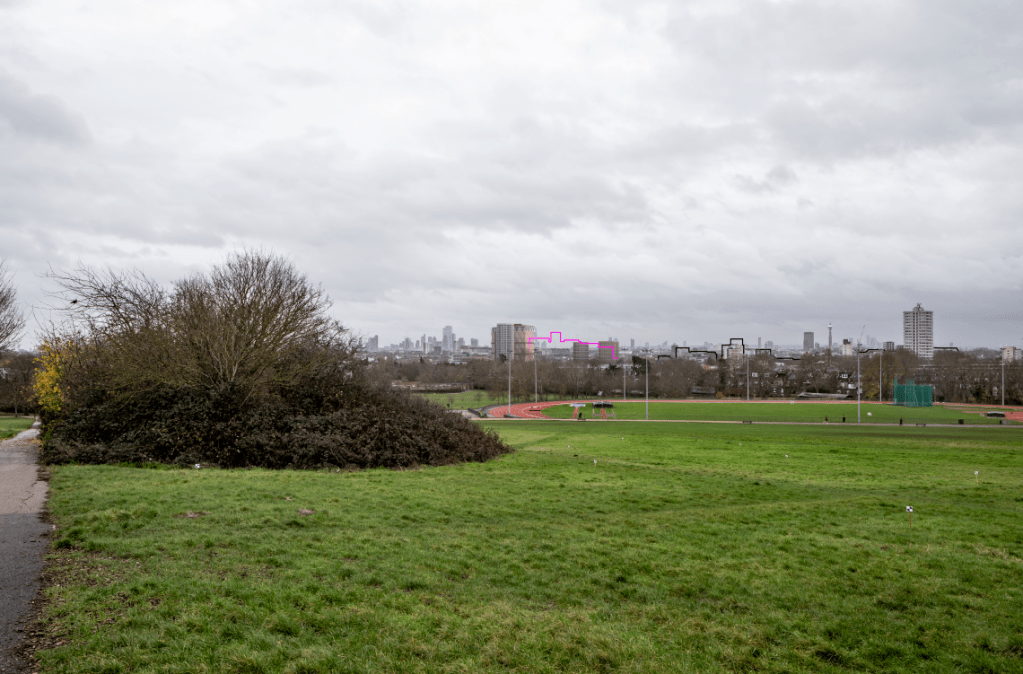
London’s protected views of St Paul’s Cathedral and the Palace of Westminster are primarily secured by the London View Management Framework (LVMF), part of the London Plan. This strategic planning guidance restricts high-rise development in specific ‘viewing corridors’, which this scheme will impact.
The proposed scheme impacts the views from Parliament Hill and Kenwood House towards St Paul’s. Compared to the elevation of Parliament Hill at 98 meters above mean sea level, the top of the film studio building would be 16 metres higher. The view from the Kenwood view point is 63 metres above mean sea level, so the film studio building would be 51 metres higher.
3.3.3. Construction and traffic
The ES predicts prolonged Major Adverse noise, dust and vibration, including deep excavation and heavy piling beside highly sensitive receptors. This breaches Local Plan A4, and no credible mitigation measures have been provided by the applicant.
Holmes Road, Regis Road and surrounding streets cannot safely accommodate years of HGV movements. This contradicts Local Plan T1/T2 and London Plan T4, which require safe, feasible construction logistics.
The developer’s own documents show harmful levels of noise, loud enough to disrupt sleep, work, study and family life on a daily basis. This would happen right beside the sheltered housing, Polka Dots Nursery and the City Farm animals.
Dust, drilling and vibration would spread across the whole neighbourhood for years, with proven impacts on stress, concentration and mental wellbeing. It is unacceptable that communities should be asked to absorb this level of disruption for six years without a more sensitive construction strategy in place.
In addition, the major studio and hotel included in the plan would bring an on-going flow of HGVs, equipment vans, contractors, taxis and ride-shares. These vehicles would spill onto already congested streets like Holmes Road, Highgate Road, Malden Road, Gillies Street and Spring Place, creating more noise, pollution and safety risks for children, cyclists and pedestrians.
3.3.4. Low quality green space
Despite the scale of the development, the usable public green space is limited and fails to meet London Plan G1/G4 or the Regis Road SPD’s expectations for a generous, connected public realm.
The green spaces provided in the plan are small and will be overshadowed by the heights of the surrounding buildings, making it difficult for planting to survive. Green spaces will also be affected by the wind tunnels that form between tall buildings, thus making them unsuitable for sustainable planting and versatile use by residents.
3.5. Environmental impacts
The unnecessary construction of high-rise buildings, including a basement the equivalent of 10-storeys deep, comes with 144,000 tonnes of carbon emissions at a time Camden Council has declared is facing a climate emergency. We strongly believe that more carbon-efficient designs should be prioritised to minimise the carbon emissions from this development.
Environmental concerns also include the smell, noise, vibration, birds, vermin, dust and air pollution associated with the proximity of the recycling centre to residential buildings. These issues have been highlighted by the Environmental Services Association, Residential Encroachment Review in October 2024. While this report focuses on waste rather than recycling centres, we are concerned that the costs associated with controlling and maintaining the correct environmental conditions for both recycling centre users and residents above will be substantial.
3.6. Cumulative impact
The proposed development for Regis Road is being put forward without a coordinated masterplan for the wider site, despite the Regis Road SPD requiring comprehensive, whole-site planning. This fragmented approach undermines the SPD’s strategy. What is needed is an overall plan for the whole area, including the Murphy site and the estate based regeneration schemes in the area.
A Cumulative Impact Assessment is urgently needed in order to assess how the anticipated flows of people, expected traffic, environmental impact and additional pressures on health and educational institutions will be managed.
We would also like to point out that there have been no joint consultations between Yoo Capital and Joseph Homes, which is baffling since the plans for both developments have been progressed in very similar time scales. Joseph Homes is responsible for almost the same proportion of the overall site but is not included in the current application.
Without seeing the plans together, residents cannot judge the suitability and impact of each development correctly.
Housing targets should not be met at the expense of residents. It is not acceptable that our predominantly working class neighbourhood should absorb such a high volume of buildings while wealthier parts of the borough are able to maintain their low-rise character.
It is clear to us that Camden Council is deliberately using a project-by-project approach to push through a generational change in planning policy, which will affect our community for years to come.
4. Conclusion
This scheme is being put forward without a coordinated masterplan for the wider area. The fragmented approach that we see, from Bacton Estate to Regis Road, undermines the local authority’s ability to provide proper planning and prevents residents from being able to accurately assess the impact of this scheme in conjunction with other parallel developments.
Because of its excessive massing, an incomplete ES, severe construction and amenity impacts, transport issues and non-compliance with the SPD, we conclude that this application should be refused or withdrawn for substantial redesign.
Camden has a long, proud and internationally recognised history of social housing and good town planning. We call on the council to honour this legacy and rethink its plans for the redevelopment of the Regis Road site as well as its approach to housing development across the entire borough.
5. Further Reading
This City of London Corporation have recently submitted their own ‘holding’ objection to the development. This can be read below:
 Bacton Towers Action